How to name a Japanese character for a story, game or anime
The quickest way to make a Japanese reader wince is a modern schoolgirl called Kiku, or an Edo swordsman called Haruto. Neither name is wrong. Each is simply in the wrong century, and a Japanese audience hears that at once.
Naming a Japanese character well means answering a few questions a native writer answers without thinking: when was this person born, where, into what kind of family, and what will other characters actually call them? Here is how I work through those questions, with the patterns that matter most and five checks I run before I commit to a name.
Start with the year your character was born
Japanese given names follow fashion closely, and the fashion of the year a character was born dates them for life, the way Ethel or Kayden would in English. Work out the birth year first, then pick a name that parents of that time would choose.
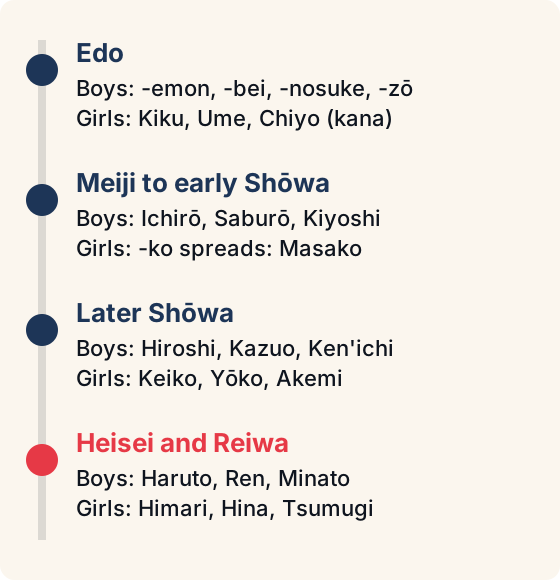
- Edo-period men carry names like Yatarō 弥太郎, Ryūnosuke 龍之介, Kinzō 金蔵 or names in -emon 衛門 and -bei 兵衛. Those endings began as titles of the imperial guard offices and turned into ordinary names over the centuries. Women's names were often two kana, such as きく Kiku, うめ Ume or ちよ Chiyo, said with the polite O- prefix: O-Kiku, O-Chiyo.
- Meiji to early Shōwa: numbered sons (Ichirō 一郎, Jirō 次郎, Saburō 三郎) and the spread of -ko 子 to every class of girl: Masako 正子, Sachiko 幸子.
- Later Shōwa: Hiroshi 浩, Kazuo 和夫, Ken'ichi 健一; Keiko 恵子, Yōko 洋子, Akemi 明美. These are the names of today's grandparents.
- Heisei and Reiwa: softer sounds and single kanji: Haruto 陽翔, Ren 蓮, Minato 湊; Himari 陽葵, Hina 陽菜, Tsumugi 紬. A child in a story set today should have one of these.
One more period detail: samurai often had several names over a lifetime, a childhood name and an adult name, plus official titles. Tokugawa Ieyasu was Takechiyo 竹千代 as a boy. A young samurai character can carry a childhood name in early chapters and take an adult name at his coming of age, which is a nice detail of the period.
Class, region and the family name
Before the Meiji period most farmers and townspeople had no official surname in public life. In a story set in the Edo period, a samurai is "Sakamoto Ryūnosuke", but the fishmonger is more naturally "Kinzō of the fish shop". After the Meiji reforms everyone registered a surname, so in any modern setting your character has one.
Surnames also suggest a region. Satō is especially common in the north-east, Suzuki around Shizuoka and Aichi, and Okinawan families carry names like Higa 比嘉 or Kinjō 金城 that are rare on the main islands. For an ordinary modern character, a common landscape surname such as Tanaka 田中, Yamamoto 山本 or Kobayashi 小林 is the right default. Save the striking surnames for characters the reader should notice.
What other characters will call them
In Japanese, how people address each other says as much as the name itself. Adults use surnames plus a suffix by default; given names are for family, close friends and children. A pair who switch from "Tanaka-san" to "Haruki" have just become close, and Japanese readers notice when that moment comes.
| Suffix | Used for | Example |
|---|---|---|
| -san | the safe default for adults: colleagues, neighbours, shopkeepers | Tanaka-san |
| -kun | boys and junior men; a teacher to a male pupil, a boss to a junior employee | Haruto-kun, Satō-kun |
| -chan | children, close friends (mostly girls), pets; affectionate | Hina-chan, Tomo-chan |
| -sama | customers, very high status, letters; sounds formal or ironic in speech | o-kyaku-sama (customer), Ōji-sama (prince) |
| -senpai | someone senior at school, club or work | Yamada-senpai |
| -sensei | teachers, doctors, lawyers, writers, artists | Kobayashi-sensei |
| -dono | historical, for samurai and officials; rare today | Sakamoto-dono |
| (none) | family, very close friends, or a deliberate show of rudeness | Haruki! |
Nicknames are usually built by shortening the given name and adding -chan or -kun: Tomoko becomes Tomo-chan, Haruto becomes Haru or Haru-kun, Ken'ichi becomes Ken-chan. A short two-syllable nickname is a natural sign of childhood friendship in a story.
Unisex names for ambiguous characters
If a character's gender should stay open, or you want a name that surprises, Japanese has a good stock of real unisex names: Hikaru 光, Akira 晶, Makoto 真, Kaoru 薫, Shinobu 忍, Aoi 葵, Sora 空, Kaede 楓. Ren 蓮 (mostly boys) and Haruka 遥 (mostly girls) cross over too. The kanji usually tips the balance: 誠 Makoto reads male, 真 Makoto can be either, and 明 Akira leans male while 晶 Akira goes both ways. Many writers lean on exactly this ambiguity for a reveal, and Japanese readers will accept it as natural.
Kira-kira names: when an unusual name works
Kira-kira ("sparkly") names give kanji readings they don't normally have. The famous example is 光宙, "light + space", read Pikachu. Since a recent revision of the family register law, parents must register the reading of a new baby's name, and readings with no recognised link to the kanji can be refused, so the most extreme cases are now blocked.
For fiction, a kira-kira name is a character note in itself. It tells the reader something about the parents and can be a running joke or a source of embarrassment. Use one on purpose, for a child born in the Heisei or Reiwa eras, and not as the default for a serious character. Readers will assume it was a choice.
Mistakes I see most often
- Western order presented as Japanese. "Haruki Tanaka" in a story set in Japan, with narration that treats Haruki as the family name. Pick an order and say once which part is the surname.
- Romaji with no kanji. If you never decide the kanji, you never decide the meaning, and fans will ask. Choose them even if they never appear in your text.
- Mixed romanization. Satō in chapter one, Sato in chapter five, Ohno beside Ōta. Choose Hepburn with or without macrons and use it throughout.
- Era mismatch. A teenager named Keiko or a samurai named Minato. Check the era table above.
- Too many rare names. If every character has a striking name, none of them stands out. Real class rosters are full of Satō, Suzuki and Takahashi.
Five checks before you commit to a name
- Birth year: would parents in that year have chosen this given name?
- Kanji and reading: does a name dictionary list this exact reading for these exact kanji?
- Meaning: does the meaning of each kanji fit, or at least not clash with, the character? 優 "gentle" in a villain's name can be a nice irony, as long as you meant it.
- Sound with the surname: say the full name aloud in Japanese order. Avoid two halves that rhyme or repeat the same syllable.
- What people call them: decide the default address (surname + -san, given name + -chan, a nickname) and who is allowed to use which.
The Japanese name generator covers the first three checks for you. Set Style to the era, pick a Gender, and every result comes with checked kanji, its reading and the meaning of each character. Use New surname or New given name to swap one half until the full name sounds right.
Questions and answers
How do I choose a Japanese name for an anime character?
Decide when the character was born and pick a given name that was fashionable then: Haruto or Himari for a child today, Hiroshi or Keiko for a parent, Kiku or Ryūnosuke for the Edo period. Then pair it with a common surname.
Should Japanese names be written surname first in English?
In a story set in Japan, surname first is more authentic and is what the Japanese government asks for. Either order is fine as long as you keep one and make clear which part is the family name.
What is the difference between -kun and -chan?
-kun is used for boys and junior men; -chan is affectionate and used for children, close friends (mostly girls) and pets. Using -chan for an adult man is either very intimate or teasing.
Can I give a Japanese character a unisex name?
Yes. Hikaru, Akira, Makoto, Kaoru, Aoi and Sora are real names used for both boys and girls, and the kanji usually suggests which way the name leans.